
Why terrazzo lasts: material, repair and reuse
Terrazzo can be a long-life floor when its mix, installation and care are resolved. A look at durability, repair, material use and environmental tradeoffs.
- terrazzo
- durability
- specification
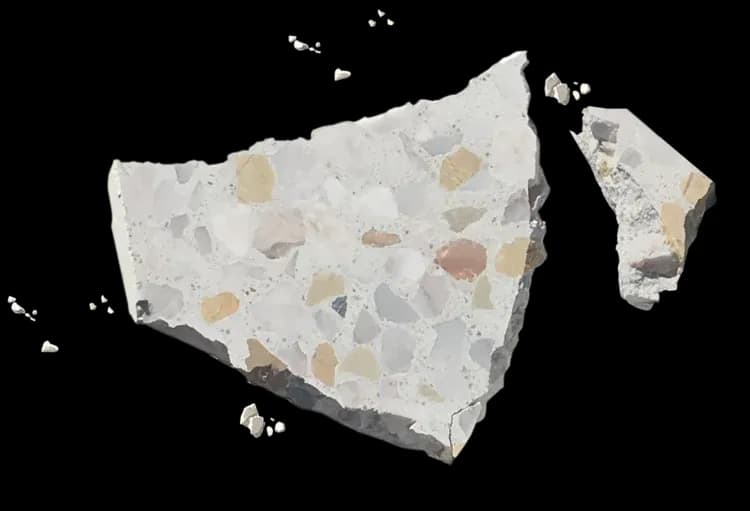
Terrazzo earns its reputation through service life, not through a label. A well-made cement terrazzo tile carries stone aggregate through its wearing layer, can be reground when the face is tired and does not depend on a printed surface to hold its appearance.
Those qualities can make it a resource-efficient floor over a long period. They do not make every terrazzo installation automatically low carbon or maintenance-free. Cement has an embodied impact, aggregates have a source, and a badly detailed floor can still be replaced early.
A material rather than a surface effect
Cement terrazzo is made by blending marble or stone chips into a cement matrix, casting the mix and grinding the cured face to reveal the aggregate. The colour comes from the matrix and the stone itself. The visible composition continues below the first fraction of a millimetre.
That full-depth character matters in use. Normal wear does not expose a different printed layer. Local scratches, pinholes or a dulled finish can often be assessed and worked on without replacing the whole field.
Why long life changes the calculation
The environmental case for any finish depends partly on how many times it must be made, transported and installed during the life of the building. A floor that remains in service through several interior refits may use more material at the beginning and less over time than a lighter finish replaced repeatedly.
That outcome is not guaranteed by the word terrazzo. It depends on four things:
- a mix suited to the expected traffic;
- a stable substrate and deliberate joint layout;
- cleaning products compatible with cement and stone;
- a maintenance plan that allows honing, polishing or local repair before replacement is considered.
If the tenancy is likely to change, choose a composition that can outlast the first colour scheme. Quiet bases and legible aggregate tend to accommodate more than one fit-out.
Repair and regrinding
The wearing layer gives a specialist room to work. A floor can be cleaned, honed and polished again when traffic has made the sheen uneven. Small damaged areas may be patched with a matched mix, although a repair should be expected to show until use and cleaning bring the surfaces closer together.
Batch records help. Keep the finish code, approved sample and installation date with the project documents. If spare tiles are ordered, store them flat and dry. Natural aggregate and cement batches vary, so a later replacement can be close without being visually identical.
Aggregate, cement and honest sustainability
Terrazzo can use crushed stone that turns small fragments into a durable face. Local aggregate can also shorten part of the supply route. These are useful material choices, but they should be recorded rather than assumed.
The cement matrix remains significant. A responsible comparison should ask for the tile thickness, expected service life, transport distance, repair strategy and end-of-life route. It should compare equivalent installed floors, not a terrazzo sample against an uninstalled alternative.
Recycling at the end of service is also project-specific. A cement terrazzo tile may be crushed as mineral material where a suitable recovery route exists, but adhesive, contamination and local facilities decide whether that happens in practice.
Maintenance is part of durability
Use a neutral cleaner and remove grit that can abrade the polished face. Avoid acidic cleaners: terrazzo commonly contains marble aggregate, and acid attacks both carbonate stone and the cementitious surface. Entrance matting reduces the load before it reaches the floor.
Slip performance must be specified for the actual finish and use condition. Polished, honed and washed faces behave differently, especially when wet. Ask for an appropriate test rather than treating one material name as a result.
Specify the floor you intend to keep
Start with the terrazzo finish library, then approve a physical sample showing the intended base, aggregate and chip grade. Resolve module, joints, edges, stairs and transitions before ordering. Include cleaning and future refinishing in the handover information.
Terrazzo becomes the enduring choice when the project protects its main advantage: it is a substantial material that can remain, be maintained and be worked again.
Hold the material before you specify it
Send the finish codes and the room, and we will come back with samples and a quote.