
Marble or terrazzo for a high traffic lobby
Seams, batch variation, repairability and maintenance decide this, not appearance. A working comparison, with two delivered Karachi projects as evidence.
- terrazzo
- natural stone
- specification
The question usually arrives as a taste question. Marble or terrazzo for the lobby. It is not a taste question, or at least it is not one for long, because both materials can be made to look calm and expensive and both are already in the building next door. The decision is settled by four practical things: how the floor is broken up, how much it varies, what happens when it is damaged, and who cleans it.
Seams
Every hard floor is a set of pieces with lines between them. The two materials put those lines in different places for different reasons.
Marble is governed by the block
A marble floor is cut from slabs, and slab size is governed by the block the slab came out of. That gives you large pieces, fewer joints and long unbroken runs of vein. In a lobby this is the material's strongest argument. A big slab laid with a tight joint reads as one continuous stone surface, and nothing else does that as convincingly.
The cost of it is that the joint layout is negotiated with the quarry, not just drawn. Vein matching, book matching and consistent slab dimensions across a large floor need the slabs selected together, from the same block where the drawing depends on it.
Terrazzo is governed by the module or by nothing
Terrazzo in tile form has a joint pattern you choose, because the tile is made to a format rather than won from a block. You can hold a small grid, or you can run a large format and reduce the joint count.
Cast in place terrazzo takes this further and removes the joints entirely, apart from the divider strips that control cracking and set the bay pattern. Those strips can be laid to the geometry of the plan rather than to the size of a piece of stone, which means the lines in the floor can be a design decision instead of a manufacturing consequence.
Batch variation
This is where projects go wrong, in both directions.
Marble varies geologically. Two slabs from different blocks of the same named stone can differ in ground colour and in the density of veining, and no supplier controls that. The control is procedural: order the whole floor from one block or one clearly matched lot, view the slabs laid out before they are cut, and hold a reserve for later repairs from the same lot.
Terrazzo varies by mix and pour. It is hand poured, so the aggregate distribution differs from tile to tile. That variation is small, consistent and the character of the material. It is also why a single sample tile is not enough to judge a floor. Look at four together.
The important asymmetry is what happens later. A terrazzo mix can be run again because it is a recipe: base pigment, aggregate, grade. A block of marble can be worked out. If a project may extend in phase two, that difference is worth more than any visual preference.
Repairability
Both materials can be ground and repolished in place, which already puts them ahead of almost everything else specified for a lobby floor.
The difference is in local damage. Chip a marble slab and the repair is a fill, matched by eye against a unique piece of stone, and it will be findable. Chip a terrazzo tile and the replacement is another tile of the same code, which is a mix that can be run again. On a floor that will take trolleys, ladders, hoardings and a fit out crew every few years, this matters more than it sounds.
Keep attic stock either way: boxed tiles from the original run, or offcut slabs from the original lot, written into the handover documents.
Traffic, grit and the entrance mat
The commonest cause of a worn lobby floor is not traffic. It is grit, walked in from outside and then ground underfoot against the surface. This applies equally to both materials, and the countermeasure is almost always undersized.
Draw a matting well long enough that a person takes several steps on it before reaching the finished floor. It buys more life out of either material than any decision downstream of it.
Maintenance
Marble is calcium carbonate, so it is sensitive to acid. Citrus, cola and a surprising number of ordinary cleaning products will etch a polished marble floor, and etching is a change to the surface rather than a stain sitting on it. A cement matrix is vulnerable to acid too, but on terrazzo the aggregate carries the appearance and the damage is less legible.
For either material the honest specification is a neutral pH cleaner, a penetrating sealer rather than a film, and a written maintenance schedule handed to the facilities team rather than filed. Most complaints about a stone floor two years in are complaints about a cleaning regime.
Two delivered floors
Both arguments exist in our own delivered work in Karachi.
Naya Nazimabad Mosque is clad in Botticino cream marble. It is the case for stone: a warm consistent ground colour, worked at scale, on a building where the material itself is meant to be understood as stone and where the surfaces are large, calm and not subject to a retail cleaning contract.
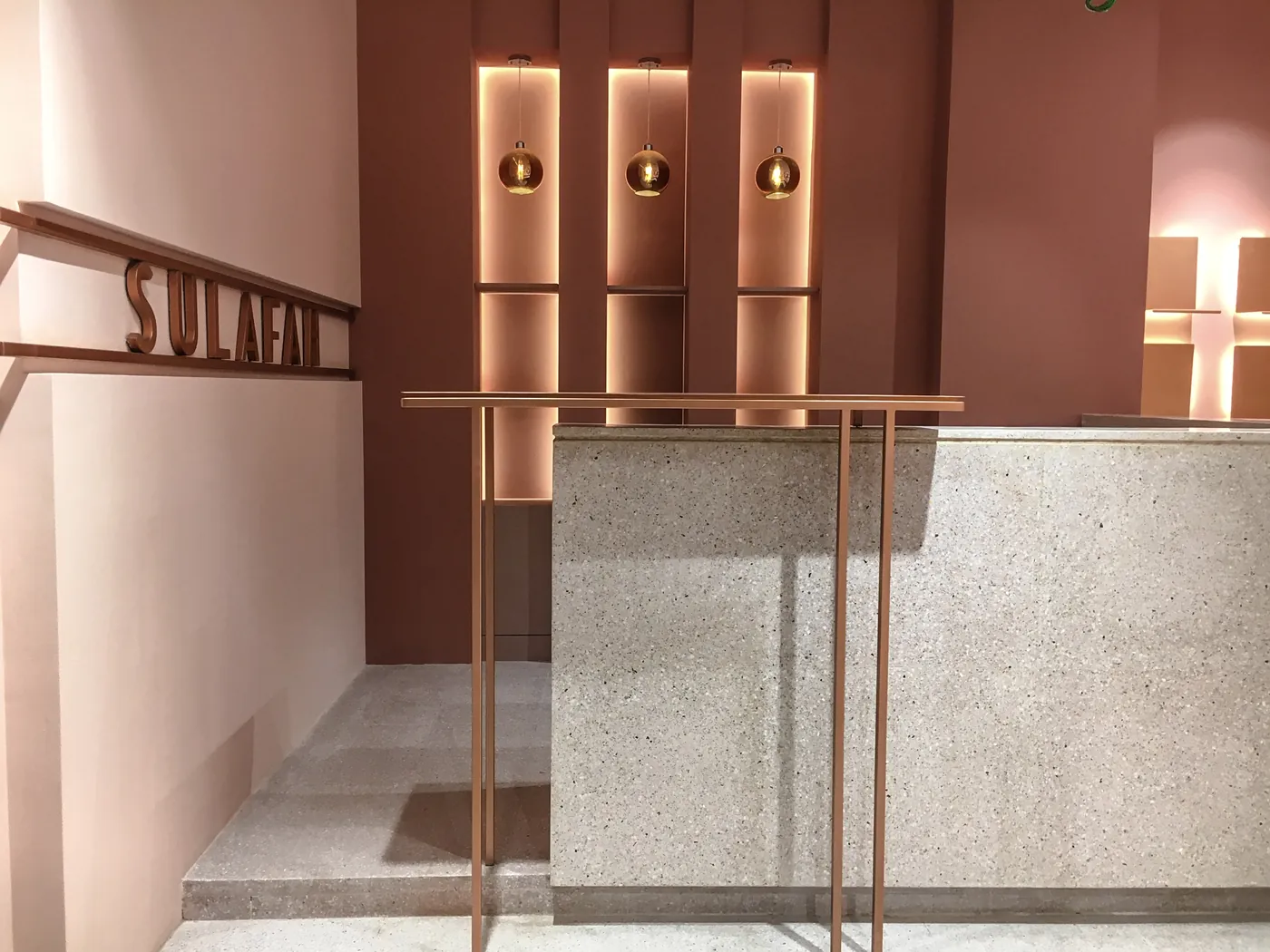
Sulafah, at Dolmen Mall Clifton, is polished terrazzo. It is the case for the other side: a fit out inside a working mall, where the counter is at hand height and gets touched all day, where the palette had to be tuned to terracotta walls and copper shelving, and where the same mix can be run again if the unit is extended or a panel is damaged. Terrazzo let the material be specified to the scheme rather than the scheme adjusted to a block of stone.
How to decide
Take the four questions in order.
- Does the design depend on large unbroken pieces and continuous vein? That is marble.
- Does it depend on a specific colour, or on matching something else in the palette? That is terrazzo, because it is mixed to a recipe.
- Will the floor be extended, phased, or partially replaced later? That is terrazzo.
- Who maintains it, and with what? If the answer is a general cleaning contractor with their own products, weight it toward terrazzo, and get the maintenance schedule signed either way.
Then request samples of both, in the finish and format you intend to use, and put them on the actual floor in the actual light before anybody signs anything.
Hold the material before you specify it
Send the finish codes and the room, and we will come back with samples and a quote.