
How to read a terrazzo code before you specify
A terrazzo code holds three decisions: base colour, aggregate and chip grade. Here is how to read one, and what each part changes on a finished floor.
- terrazzo
- specification
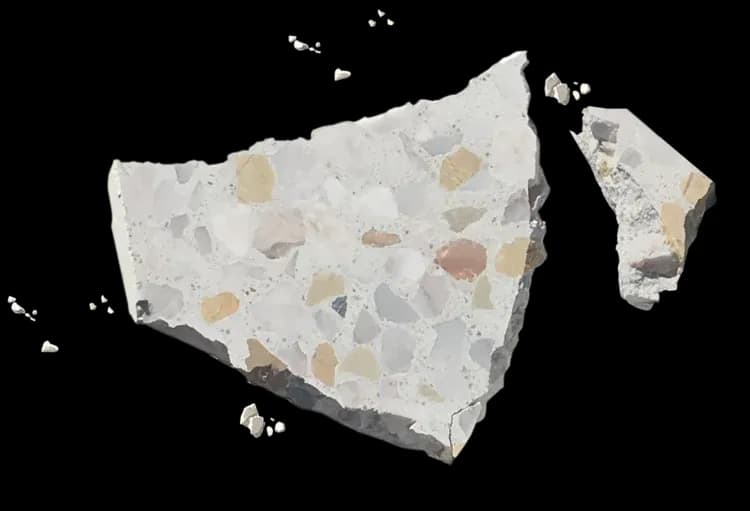
A line on an AFINISHES sample sheet reads ATW-1001, white base, Greece white
chips, size 3. That is not a product name. It is a recipe, and it carries the
three decisions a terrazzo floor is actually made of: the colour of the cement
matrix, the stone suspended in it, and how coarse that stone is graded. Read the
line properly and the tile that arrives will look like the floor you drew.
The anatomy of a code
There are 38 coded finishes in the current book, grouped by base colour. The prefix names the group and the number is the position within it.
ATWwhite base, eleven finishesATGgrey base, nine finishes, light or darkATYyellow base, seven finishesATRred base, six finishesATMGmint green base, four finishesATBbeige brown base, one finish
The number is issue order, not a ranking. ATW-1009 is not a better tile than
ATW-1002. It is a later mix. Nothing in the code implies quality, price band
or availability, so do not read a hierarchy into it.
The base does most of the work
The base is the cement matrix the aggregate sits in, pigmented through the body.
At normal viewing distance the base is what a room reads as, because it is the
majority of the surface area. Stand two metres back from a white base tile and
you see a pale floor with texture in it. Stand two metres back from ATG-2002,
a dark grey base with Greece white chips, and you see a dark floor that
sparkles.
This matters for how you brief a client. If somebody asks for a light lobby, the decision is the base. The aggregate is the second conversation.
Grey deserves a note of its own. The book distinguishes light grey, grey and
dark grey inside the same ATG prefix, and the difference between ATG-2001
on a light grey base and ATG-2008 on a dark grey base is larger than the
difference between most aggregates. Read the base description on the sheet, not
just the prefix.
The aggregate is the pattern
The aggregate names are descriptive and they are printed exactly as the mix is run: Greece white, Greece red, Salt pepper, Chocolate, Black, Cloud, Cloud white, Cloud black, Red and white, Yellow gold, Verona, Verona black, Light yellow, Emerald and Rogwal black.
Two things follow from this. First, the aggregate sets the contrast. A white
base with Greece white chips is a quiet, near monolithic surface. The same white
base with Black chips, which is ATW-1005, is a graphic floor with strong
figure and ground. Second, the aggregate is stone, so it holds its colour. The
pattern is not printed on the surface. It runs through the depth of the tile,
which is what the broken edge in the photograph above shows.
Chip grade is the number that decides everything else
The grades in the book are 1.5, 1.75, 2 and 3. The grade describes the size of the crushed stone, and it changes the tile more than most specifiers expect.
The clearest way to see it is to compare two codes that differ by nothing else.
ATW-1001 and ATW-1002 are both a white base with Greece white chips. One is
size 3, the other is size 1.5. Same materials, same works, same polish. They do
not read as the same floor.
Size 1.5
A fine grade gives a dense, even scatter. From standing height it resolves as a tone rather than a pattern, closer to a honed stone than to a mosaic. It suits small rooms, bathrooms, stair treads and anywhere the floor is competing with something else that has to win, such as a patterned wall or a strong joinery colour. It also tolerates smaller tile formats, because a fine grade does not need a large field to make sense.
Size 3
A coarse grade gives large, individually legible pieces of stone. It needs area. On a lobby floor or a long corridor it reads as a proper aggregate surface with depth and movement. In a two metre wide bathroom it can look like the pattern has been cropped, because it has.
One honest note on the book. ATG-2006, a grey base with Rogwal black chips,
carries no grade on its sheet. If that finish is on your shortlist, ask for the
grade with the sample rather than assuming a number.
What changes underfoot
Grade also changes the feel of a polished floor very slightly, because stone and cement wear at different rates. Over years of traffic a coarse aggregate develops a marginally more articulate surface than a fine one. Neither is a slip specification. If the floor is a wet area, a ramp or an external threshold, the finish decides that question, not the grade, and washed terrazzo is the finish that answers it.
What changes under daylight
Karachi daylight is hard, high and warm, and it moves. Under a 4pm sun through
a west window, a white base with Yellow gold chips such as ATW-1008 warms
noticeably. Under a north lit stairwell the same tile cools and the gold reads
as brass. Grey bases are the most stable across the day, which is one reason
they run through so many commercial projects here.
Two practical habits are worth building.
- Look at the sample in the actual room, at the hour the room is used, laid flat on the floor rather than held up to a window.
- Look at four tiles together, not one. A single sample tells you the mix. Four tiles tell you the floor, including how much variation the mix carries from pour to pour.
Writing the line into a schedule
A specification line that a works can act on without a phone call contains the
code, the finish, the format and the edge. For example: ATG-2007, grey base,
black chips, size 3, polished, in the format and edge detail agreed for the
lobby. The code carries the first three decisions. You carry the rest.
Then ask for the samples with the room named. Terrazzo is hand poured, so the question that matters is not whether the tile matches a photograph. It is whether four of them, side by side, in the light of your room, make the floor you drew.
Hold the material before you specify it
Send the finish codes and the room, and we will come back with samples and a quote.